Feeling the Market Downturns? Put Options Might Help

Markets run in cycles—sometimes up and sometimes down. The good news is that Put Options are available to investors trying to protect themselves from or take advantage of the downside. It's essential to understand the risks as well as the potential benefits.
Buying Puts for Protection
You hold some stocks in your portfolio, but you're not comfortable with the thought of them dropping below a specified level. Is there a way to protect those stocks from sharp price drops? Options aren't always for speculation and were initially designed for risk management. Put Options can be helpful to protect from a decline in the holding shares, just as we insure our homes and cars. How does this work? Let's see!
A put buyer is entitled to the right to sell 100 XYZ shares at a fixed price (known as a strike price) within a specified period. The below contract allows the put buyer to sell 100 XYZ shares at USD155. Suppose the buyer chooses to exercise his right to sell the underlying shares. In that case, he will receive total proceeds of USD15,500 meanwhile delivering his XYZ shares to the counterparty.
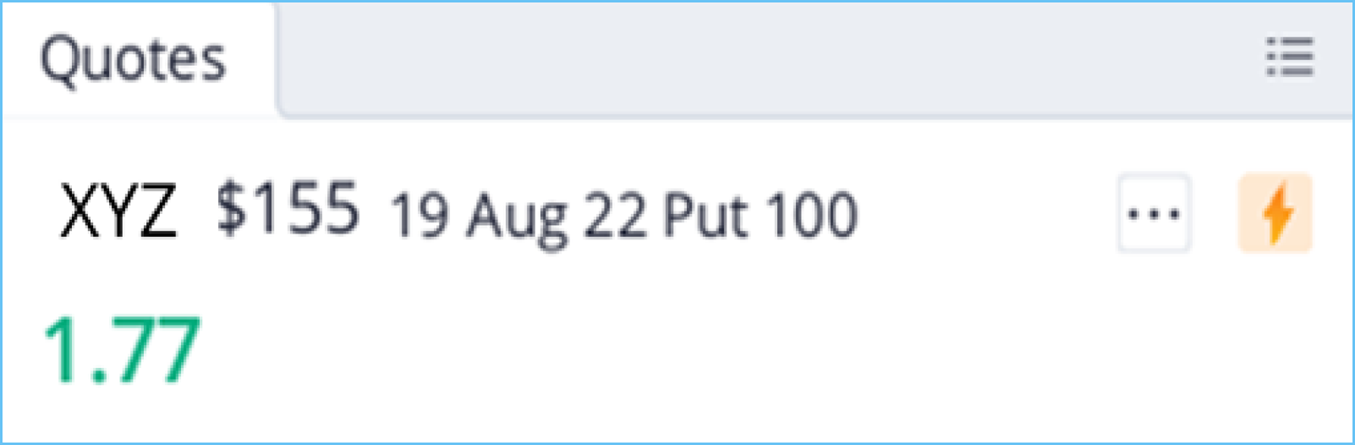
Here's an example: Say you own XYZ stock trading at $160 per share and worry about how some potential news may affect its near-term prospects. So, you may buy the above Put Option, which costs you USD177. If XYZ stock drops below USD155 by 19 August 2022, the buyer can still sell the shares at USD155 no matter how low the market price is. Thus, you've capped your risk to the downside of the stock. When the stock price remains sideways or trends upside, it is not economical to exercise the put option, so the Put Option is likely to expire worthless. The investor keeps the potential profit if the stock continues to rise while holding the underlying assets.
Reading this far, you may have already noticed that buying puts on your stocks is like your home insurance. Knowing that your stock position can be protected from a loss may make you feel more comfortable. Therefore, buying puts on your stocks is called Protective Put Strategy.
A Basic Bearish Strategy: Buying Puts
During downtrends, the average investor may react like this: i) He watches his portfolio lose value and does nothing, hoping the market will eventually turn around. ii) he takes money out of the market and hopes that the market doesn't turn around immediately.
It's likely that neither choice feels like a good option.
The good news is that some options strategies are proactive and may be appropriate for long, sustained bearish markets. Let's start with the basic bearish strategy: Buying puts.
Suppose you expect the stock XYZ may drop significantly, so you buy the XYZ USD155 19 August 2022 Put for USD1.77. Therefore, you have the right to sell XYZ at USD155 before expiration. Unlike the above Protective Put Strategy, you buy the Put Option without holding the underlying asset. If this bearish view is correct, your Put Option position will be in-the-money (ITM). You can choose to liquidate them to take profits, or to exercise them to sell the underlying stock at the strike price higher than the market price. In practice, whether you can sell the underlying stock without holding them in the first place is subject to account type, buying power, and underlying shortable eligibility.
If XYZ settles at expiration at USD155 or higher, the put expires with no value, and you lose USD1.77, or USD177 per contract (100 shares per contract). No matter how much higher than $155 per share XYZ settles (USD200, USD500, even USD1,000 per share), your maximum potential loss is limited to the amount you paid for the put option. The most you can lose is the 100% premium paid for the option contract if the stock price moves against you. Unlike short-selling stocks, where losses can be unlimited, the put option strategy defines a strict limit to your financial loss, no matter how far the outcome deviates from your speculation.
In another scenario, if XYZ drops way below USD155, say to USD140 per share, the market price of the put options you previously bought will increase. And you can get profits when you sell your Put Option.
Buying Puts VS Short Selling
Both buying Put Options and short selling are bearish strategies, for they are profitable as the market drops. The two strategies have features in common, but investors should understand the difference.
The first difference lies in the trader’s account type. Short selling is a strategy exclusive to margin account holders. It involves selling borrowed securities with the aim to buy them back at a lower price. On our platform, margin accounts can short sell securities that belong to the specific set of supported symbols or counters eligible for short selling. In contrast, long put options are open to both cash accounts and margin accounts. Buying a put can be an alternative if your account is a cash account. So, investors can take active trading strategies instead of just looking at the bear eating away at their portfolio. Moreover, some shares are not available to sell short, whereas Put Options on those non-shortable securities may be an alternative.
The second difference lies in the scale of maximum loss. We have mentioned that the maximum potential loss of buying puts is what you already paid for the contract, no matter how expensive the price rises. In contrast, a short seller may face an unlimited risk as the stock's value can climb infinitely.
Short sellers should also meet the margin requirements and must have the funds in the account to cover the short position. As the price of the shorted asset rises, the maintenance requirement to cover the position will also rise, decreasing the remaining available balance. Conversely, Put Options cannot be held on margin and can only be purchased with cash.
Let's Recap
This lesson covered two scenarios about buying Put Options:
- A Put Option can be used as a hedge against a stock position, providing temporary protection against the downside.
- Investors who buy Put Options have a bearish outlook on the market.
- Investors should know the difference between buying puts and short selling.

All Comments