The Over-the-counter Market

When it comes to trading in the secondary market, an exchange is often the first thing we think of. However, there is another important market we must not ignore—the over-the-counter market.
What is the Over-the-counter Market?
Over-the-counter (OTC) refers to trading securities outside official stock exchanges. A wide range of securities can be traded over-the-counter, including common stocks, American Depository Receipts (ADRs), and even derivatives. ADRs refers to securities issued by a bank representing shares in a non-U.S. company.
Many companies choose to trade their shares over-the-counter because they cannot meet the listing requirements of official security exchanges. Another possible reason is that they are not willing to (or cannot) afford the listing fees of exchanges.
The OTC market provides investors opportunities to trade securities outside official exchanges. Investors can add stocks already listed in another country to their portfolio. With varying asset requirements and relatively low listing fees, the OTC market offers a place for large groups of unlisted companies to trade. Many of them are in startup or growing stages, providing huge upside potential at low share prices.
Tiers of OTC Markets
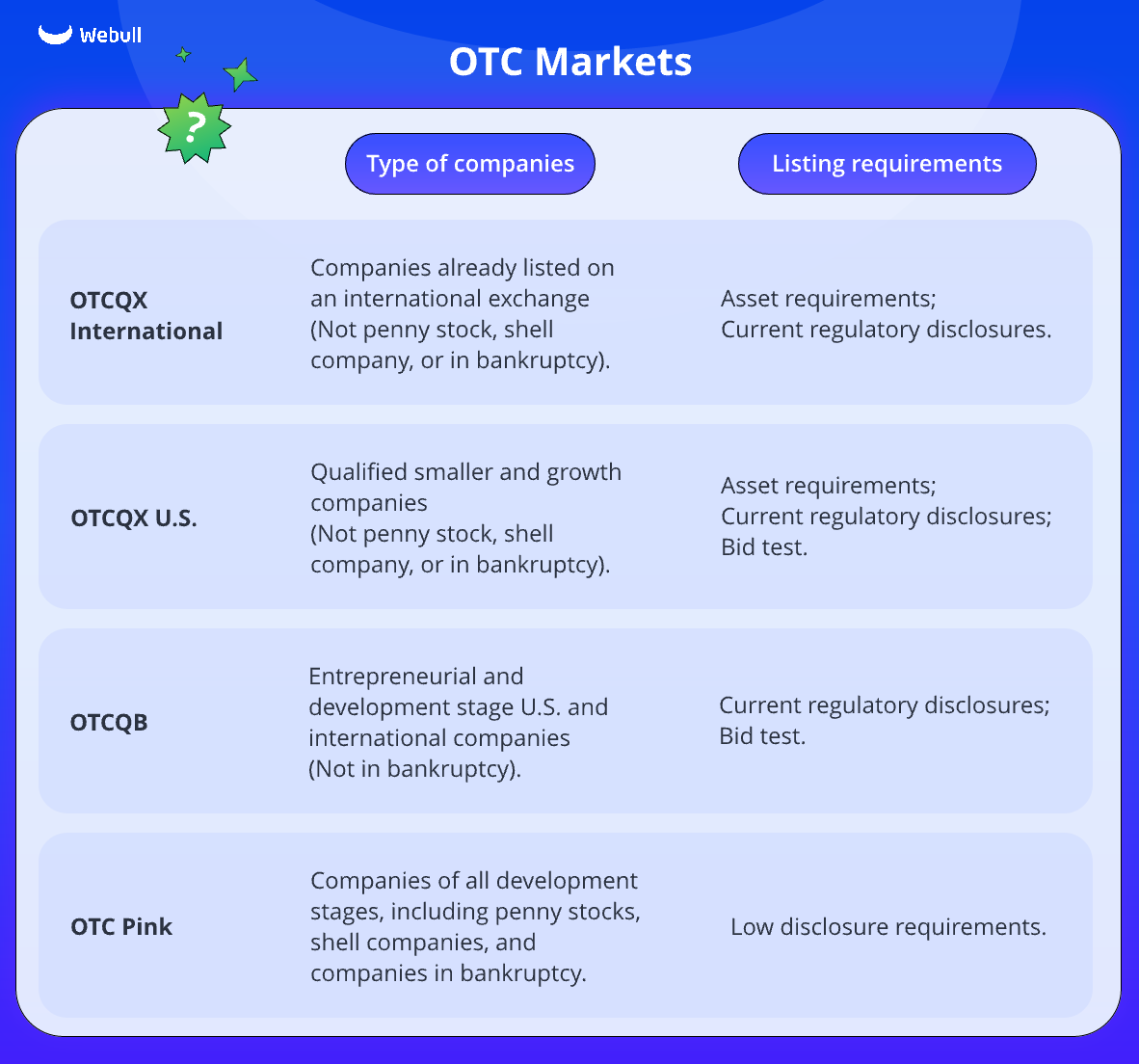
Securities trading in the OTC markets are mainly divided into three markets—the OTCQX, OTCQB, and OTC Pink, all provided by the OTC Market Group. The OTCQX market ranks the first in high listing requirements, OTCQB the second. OTC Pink has no formal listing requirements. See below for a brief comparison.
What are the risks involved in trading OTC securities?
Although OTC trading allows investors to trade low-priced stocks and ADRs, the possible enormous risks must not be ignored. Apart from the same market risk as generated in trading listed stocks, other types of risks should also be taken into consideration.
Business risk
Different tiers of OTC markets pose different listing requirements regarding minimum assets, quote price, reporting status, and financial information disclosure. This means the quality of OTC securities could vary greatly. Companies with little or no financial information are likely in bad management and poor financial status. Investors should check company information and financial reports before investing in OTC securities.
Liquidity risk
OTC securities do not have a centralized trading venue like listed stocks. This would make some micro-capital companies with low trading volume even more illiquid. In an illiquid trading environment, orders take time to fill or fill at unfavorable prices. Investors can use limit orders instead of market orders to avoid situations where transaction price deviates too much from the market price.

All Comments