Long Call Option Strategy

A long call option strategy entails purchasing a call option by itself. Investors with an investment objective of growth and a bullish market view will pursue the long call option strategy. The investor will aim to take profit from their options contract when the underlying asset’s price increases.
For this, the investor pays a premium for a call option which gives him the right to purchase 100 shares. While there is theoretically infinite upside potential in buying a long call option, the investor will lose the entire amount invested or the premium paid with a long call option strategy before or by the expiration date. This happens if the underlying asset underperforms.
Therefore, a long call option strategy requires a considerable level of risk tolerance. An investor who has a bullish outlook that anticipates the stock price to rise beyond a specific price by a set date utilises a long call option strategy.
Let’s See an Example:
An investor anticipates that the stock price of ABC will go up in the next 3 months. ABC trades at USD10, while a 3-month call option with the USD10 strike price trades at USD2.
The investor buys one ABC call option at the USD10 strike price with 3 months until the expiration date for a premium of USD2.
The maximum potential profit is theoretically infinite since the price in theory, could continue to rise to any price. This is calculated as follows:
- Maximum Profit per Option = (Theoretical Infinite Price – Call Option Strike Price - Premium) x 100 shares
- USD∞ = (USD∞- USD10 + USD2) x 100 shares
The maximum potential loss is the USD2 premium paid for the call option multiplied by 100 shares. This is calculated as follows:
- Maximum Loss per Option = Premium Paid x 100 shares
- USD200 = USD2 x 100 shares
The break-even point for an options contract [KW1] is the USD10 strike price of the option plus the USD2 price of the premium paid. This is calculated as follows:
- Break-even Point = Strike Price + Premium Paid
- USD12 = USD10 + USD2
The profit and loss of the long call option strategy until the expiration date is depicted in the chart below.
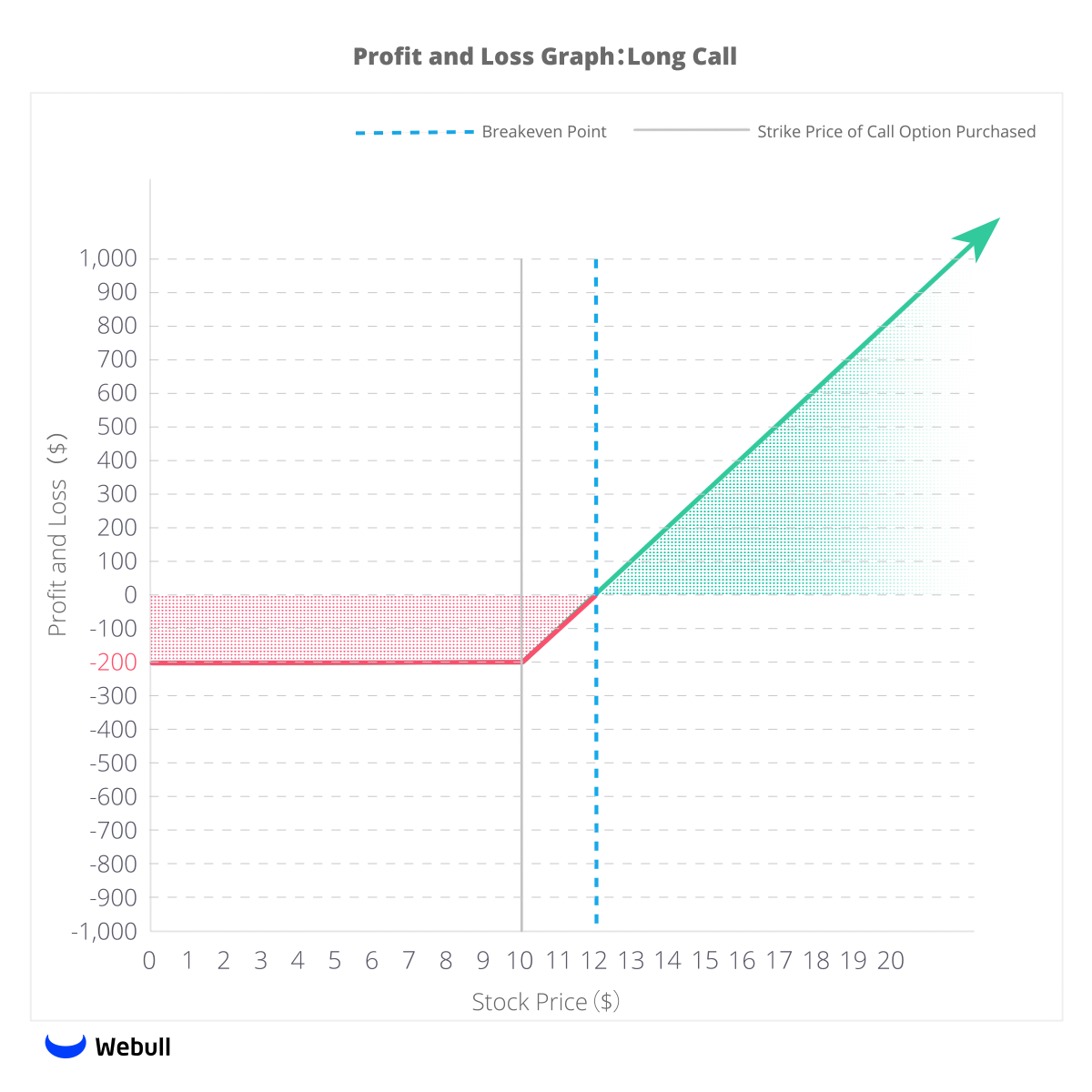
The chart shows the potential profit and loss on the y-axis versus the corresponding stock price on the x-axis until the expiration date.
The long call will be profitable if ABC trades up to USD12 and beyond. Theoretically, an investor with a long call has infinite profit potential as the price can reach any level. Conversely, the maximum potential loss is USD200, the premium the investor paid for the call option. The break-even point is USD12, which is the strike price of USD10 plus the premium paid of USD2.
If ABC is above USD10 and the investor has enough buying power to exercise the call option, he can purchase 100 shares of ABC for USD10 a share. He can exercise the option at any time ABC trades above USD10. However, he only breaks even on his call option strategy if the price of ABC breaks USD12. Suppose by the expiration date, the price is above USD10, and there is enough cash in the investor’s account to exercise the call option. In that case, the options contract will be exercised automatically, resulting in 100 shares long of ABC at USD10 as of the next trading day. Conversely, if the investor does not wish to buy shares of ABC or does not have enough buying power to purchase the shares, he can instead sell the call option before the expiration date.
If the stock price of ABC fails to stay above USD10 by the expiration date, the call option will eventually expire worthless, and the investor loses his entire amount of USD200 invested.
Disclaimer: Options trading involves significant risk and is not suitable for all investors as investors may be exposed to potentially rapid and substantial losses. Options trading functionality is subject to Webull Securities' review and approval. Please read Characteristics and Risks of Standardized Options before investing in options.
